Case study: Saga App Content Strategy & Thought Leadership
Context
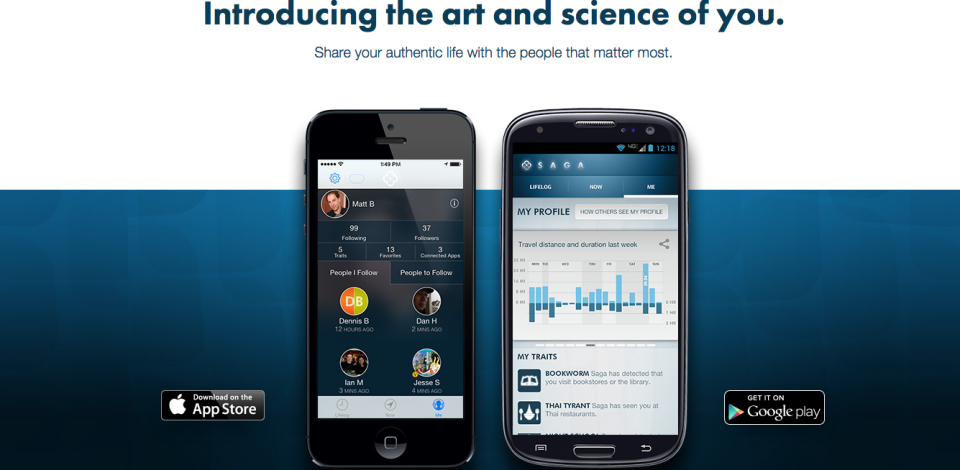
Paul Allen funded A.R.O. launched the Saga lifelogging app in 2013 to use location-based contextual awareness to serve users an automatic diary of their daily activity, alongside behavioral observations and useful information. As Content Strategist, I led both content marketing strategy and UX content design for the iOS and Android apps.
Problem
As a new app released in a crowded market to a niche audience, gaining visibility and adoption was an uphill battle. At the time, an app using always-on location tracking needed to prove significant value and high trust in order for users to believe using it was worth sharing their location data and risking battery drain.
What I did
Saga Content Strategy
Traits: rules & copy
One of the unique features of the Saga app was an automated badge reward system called Traits. These badges would be awarded based on repeated visits to specific types of businesses. For example, multiple visits to bookstores could earn a user the Bookworm Trait.
I defined the rules for assigning traits, authored many of the Trait names and microcopy, and worked with a professional comedy writer to build out the full library of over 200 Traits.
UX content design
As the only Content Strategist working for the small startup, I collaborated closely with UX designers to create button text, microcopy, and calls-to-action throughout the app.
Contextual content delivery
Partnering with product engineers, I created rules for dynamic, contextual content delivery, including travel times, weather updates, nearby events, and personalized behavioral insights.
Transactional email strategy
I wrote and designed transactional emails to be delivered to Saga users via Mailchimp’s Mandrill transactional email service and triggered by user actions.
Thought Leadership/ Marketing
Saga blog & email newsletter
I worked closely with A.R.O.’s PR agency to launch the Saga blog and email newsletter in advance of the inaugural app launch. I wrote researched thought leadership posts to draw traffic to the Saga website.
TechCrunch article
I authored “Winter is Coming for Wearables,” which was published by TechCrunch as a thought leadership piece targeting the Quantified Self audience for increased brand visibility and authority for Saga.
Grandma was a Lifelogger/ NPR
After discovering my grandmother’s 1942 diary from the year she turned sixteen, I created and delivered a talk at the 2013 Quantified Self conference in San Francisco titled, “Grandma was a Lifelogger.” The talk explored the ways that my grandmother’s diary served as a diary, and the patterns from her teen years that emerged in my own life seventy years later.
The conference organizers asked me to give the talk a second time for the closing session, and I was subsequently contacted by NPR to be interviewed as an expert in the Quantified Self space.
Telling Stories with Data
For the Quantified Self conference in Amsterdam in 2014, I collaborated with my Data Scientist colleague, Adrienne Slaughter, PhD, to present a workshop on “Telling Stories with Data.” We used my exploration of my grandmother’s diary and Dr. Slaughter’s health data to demonstrate methods for drawing out narratives from qualitative and quantitative data.
MWC Barcelona
After the success of the TechCrunch article and NPR interview, I joined a panel on Digital Identities sponsored by NXP at Mobile World Congress 2015 in Barcelona.
Outcomes
By the time the startup was shuttered in 2014, we had gained an audience of more than 12,000 enthusiastic users. The Traits were delightful Easter Eggs for those who used the app regularly, and the Quantified Self community expressed disappointment when the app was ultimately shut down.
I continued to write thought leadership pieces on technology and the Quantified Self for the Vulcan Innovation Lab after A.R.O. was shuttered.